

In the highly specialized field of mechanized rock excavation, the Raise Boring Machine (RBM) represents a massive capital investment. The efficiency of an RBM hinges entirely on the performance of the Cutting tools mounted on the reamer head. Among these, the solid tungsten carbide roller cone cutter is the primary interface between the machine and the rock mass.
For end-users, the critical pain point is the cascading cost of unplanned downtime. When a roller cone cutter fails prematurely—whether through insert spalling, abrasive wear, or bearing collapse—the entire operation halts. With typical RBM rig rates ranging from $800 to $1,500 per hour, lowering a massive reaming head down a 500-meter shaft to replace a single damaged cutter consumes expensive shift hours and destroys project margins. Maximizing the lifespan of these cutters is a core financial strategy.
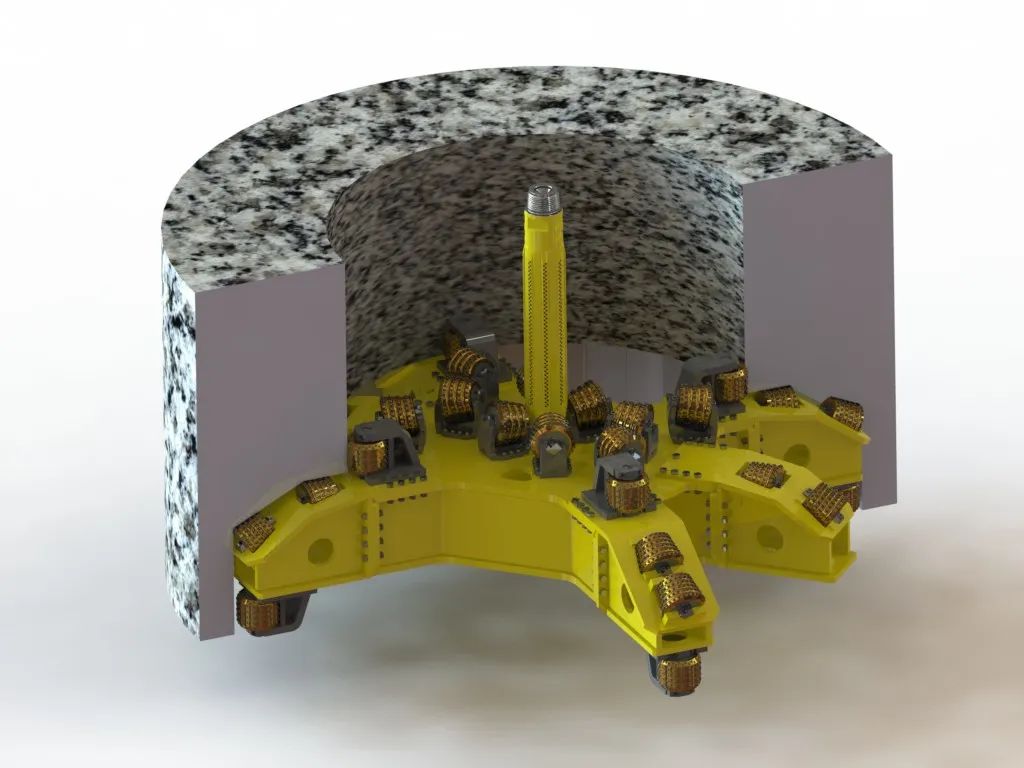
To maximize tool lifespan, users must engineer the material science of the Tungsten Carbide Inserts (TCI) to match the specific geology. Tungsten carbide (WC) is exceptionally hard but inherently brittle. To withstand high-impact raise boring, WC grains (typically 1 to 3 microns in size) are sintered with a metallic Cobalt (Co) binder.
This creates a strict Hardness-Toughness trade-off that operators must specify based on geotechnical data:
Low Cobalt (6% - 8%) / Fine Grain: Produces an insert with extreme hardness (often exceeding 90 HRA) and phenomenal resistance to abrasive wear. Application: Ideal for highly abrasive, homogeneous rock with a high Cerchar Abrasivity Index (CAI > 4.0) and UCS exceeding 200 MPa, such as massive quartzites.
High Cobalt (10% - 14%) / Coarse Grain: Yields an insert with higher fracture toughness, capable of absorbing severe dynamic impacts without shattering. Application: Mandatory for highly fractured, vuggy rock with a low Rock Quality Designation (RQD < 50%), where sudden shock loads would instantly shatter a low-cobalt insert.
To prevent premature failure, operators must accurately diagnose physical wear patterns. Wear on solid tungsten carbide roller cone cutters generally falls into four distinct categories:
Occurs when rock particles are harder than the cobalt binder. Highly siliceous rocks gouge out the softer cobalt, leaving the rigid tungsten carbide grains unsupported until they are swept away.
Visual Indicator: Inserts appear rounded, flattened, or "polished," losing their distinct protruding profile.
Operational Fix: Ensure adequate bailing velocity (> 1.5 m/s) to evacuate silica dust. For future procurement, select a lower-cobalt carbide grade if the rock mass is homogeneous.
Common in softer, argillaceous rocks (like shales). High localized heat causes rock particles to micro-weld to the carbide. As the cutter rolls, these welds are torn away, pulling microscopic fragments of carbide with them.
Visual Indicator: The insert surface appears rough, micro-pitted, and irregularly textured.
Operational Fix: Optimize bailing fluid flow to rapidly cool the inserts and clear the "sticky" cuttings. Reduce applied thrust to prevent the cutter from skidding.
A catastrophic failure mode prevalent in fault zones or mixed geology. When the RBM transitions abruptly from a soft void into a 250 MPa rock ledge, the exponential spike in Hertzian contact stress exceeds the tensile limit of the carbide.
Visual Indicator: Large, jagged chunks of the carbide insert are broken off, or the insert is sheared entirely flush with the steel cone body.
Operational Fix: Immediately reduce ROP and RPM when navigating fault zones. Specify high-cobalt (12%+), spherical (dome) inserts to maximize fracture toughness.
Intense friction generates localized temperatures exceeding 400°C at the insert tip, which is then instantly quenched by bailing water. This rapid cyclic thermal shock creates micro-fissures in the carbide matrix.
Visual Indicator: A fine "spiderweb" of microscopic cracks on the insert surface, leading to eventual fragmentation.
Operational Fix: Never abruptly restart fluid circulation if cutters have been running dry and have overheated; allow them to cool ambiently to prevent thermal shock.
The operational parameters executed by the RBM driller directly dictate the ultimate lifespan of the solid tungsten carbide cutter.
The Drilling Threshold: ROP does not increase linearly with thrust. Operators must conduct a "drill-off" test to find the exact thrust required to initiate brittle rock fracture (the chipping phase). Operating below this threshold causes the cutters to merely grind the rock into powder, accelerating abrasive wear by up to 300% without advancing the shaft.
RPM and Heat: Heat generation scales with velocity. If thrust is high (to break >200 MPa rock), RPM must be proportionally reduced (e.g., dropping from 12 RPM to 6 RPM on a large diameter reamer) to keep internal bearing temperatures below the critical 150°C seal-degradation limit.
Strategic Repositioning: Outer gauge cutters travel exponentially further per revolution than inner stem cutters. Implementing a strict maintenance protocol to rotate partially worn gauge cutters to inner-row positions can extract maximum lifespan from the carbide matrix before full replacement is required.
Q: Why are my tungsten carbide inserts chipping off cleanly in large pieces rather than wearing down smoothly?A: Clean macro-chipping indicates the fracture toughness of the carbide is too low for the dynamic shock loads of the rock mass. This typically occurs when a low-cobalt (e.g., 6%-8%) cutter designed for solid, homogeneous rock hits a fractured fault zone (RQD < 50%). Solution: Switch to a high-cobalt (10%-14%) insert with a blunter ballistic or spherical profile to absorb the impact.
Q: What causes the steel cone to wear away, allowing perfectly good carbide inserts to just fall out?A: This failure mode is known as "insert drop-out" or "matrix erosion." It is almost always caused by inadequate bailing fluid velocity at the cutting face. When cuttings are not flushed away, the RBM re-grinds the abrasive rock paste, which acts like a grinding wheel against the steel cone. Solution: Increase bailing water pressure/volume and ensure your next cutters feature heavy tungsten carbide hardfacing on the steel shell.
Q: My cutters look fine externally, but they suddenly locked up and stopped spinning. Why?A: Sudden lock-up without external insert wear is a classic bearing and seal failure. Excessive thrust combined with high RPM raises the internal temperature beyond the drop point of the lubricating grease and the thermal limit of the elastomeric seals (>150°C). Once the seal fails, highly abrasive silica slurry floods the bearings, destroying them in minutes. Solution: Optimize your Thrust-to-RPM ratio to manage heat, and upgrade to premium cutters equipped with internal pressure compensators and metal face seals.
Roller cutters is suitable for mining ventilation shafts, the main cone adopts large diameter wedge insert for higher wear resistance. High quality NSK thrust bearing which improve the bearing load. Floating oil sealing imported from Germany is a guarantee of long sealing time and high bearing life. The combination of A and B cutter achieves full coverage of the bottom hole crushing zone.
Characterized by excellent rock-breaking performance, high wear resistance, high overall strength, long service life, good manufacturability, and ease of assembly, disassembly, and maintenance, these products have successfully replaced imported alternatives.
Tungsten carbide insert cutters are designed for use in shaft sinking projects within rock formations featuring a uniaxial compressive strength of 80–180 MPa.
The BSII-XC series wedge-tooth cutter is intended for soft rock formations and topsoil layers with a uniaxial compressive strength of less than 40 MPa in coal mine shaft sinking projects. The BSII-XZ series wedge-tooth cutter is designed for rock formations with a uniaxial compressive strength of less than 80 MPa (ranging from soft to medium-hard) in coal mine shaft sinking projects.
These products are suitable for drilling rigs used in coal mining, water conservancy, bridge construction, building foundation engineering, and similar projects.
 RELATED
This website uses cookies to ensure you get the best experience on our website.





 Phone
Phone E-mail