
Abstract:For raise boring terminal users, operational adaptability and equipment efficiency are paramount. Historically, altering the diameter of a borehole required replacing the entire reaming head—a costly, time-consuming, and logistically complex process. The introduction of the "D" type reaming head, featuring a new and improved gauge saddle system, has revolutionized this process. This comprehensive guide explores the mechanics of the modular gauge saddle system, detailing how operators can reduce reamer diameters simply by changing the gauge saddles. Furthermore, it strictly defines the "Rule of Four" for maintaining the correct Cutting profile, ensuring end-users can maximize the lifespan of their 7008-2XXX series saddles while maintaining peak excavation performance.
Core Keywords:D type reaming heads, Raise boring gauge saddles, RBM diameter reduction, Reamer profile maintenance, 7008-2XXX saddles, Raise boring operational efficiency, Seat of Cutter, Reaming head dressings.
In the highly specialized field of mechanized rock excavation, the Raise Boring Machine (RBM) is a critical asset. Whether constructing ventilation shafts, ore passes, or penstocks, the reaming head is the primary tool engaging the rock face. As mining and civil engineering projects become more complex, the demand for flexible, adaptable equipment has surged.
In older generations of raise boring equipment, the reaming head was a static tool. If a mine plan required a transition from a 2.1-meter shaft to a 1.8-meter shaft, the site required an entirely different reaming head. Transporting these massive steel structures underground, positioning them, and maintaining a fleet of different-sized heads was a logistical nightmare for end-users.
The industry's response to this challenge is the "D" type reaming head. Engineered with an improved, modular gauge saddle system, the "D" type head empowers terminal users to adapt to varying shaft diameter requirements without the need to swap out the core structural frame.
To understand the advantage of the "D" type head, one must understand the function of a gauge saddle (or gauge seat of cutter).
While inner saddles focus on breaking the rock nearest to the pilot hole (spalling), the gauge saddles are mounted on the absolute outermost periphery of the reaming head. The cutters mounted in these gauge saddles dictate the final, exact diameter of the shaft being bored. They also endure the highest rotational speeds and travel the greatest distance per revolution, making them subject to intense wear.
The "D" type reaming heads implement a standardized outer mounting frame. Instead of the frame itself dictating the final cut, the radial reach is determined by the specific geometry of the gauge saddle bolted to the periphery.
By unbolting the existing gauge saddles and replacing them with a different set from the 7008-2XXX series, the terminal user can effectively shrink the cutting diameter of the reamer. This innovation transitions the reaming head from a single-use tool into a versatile, multi-diameter platform.
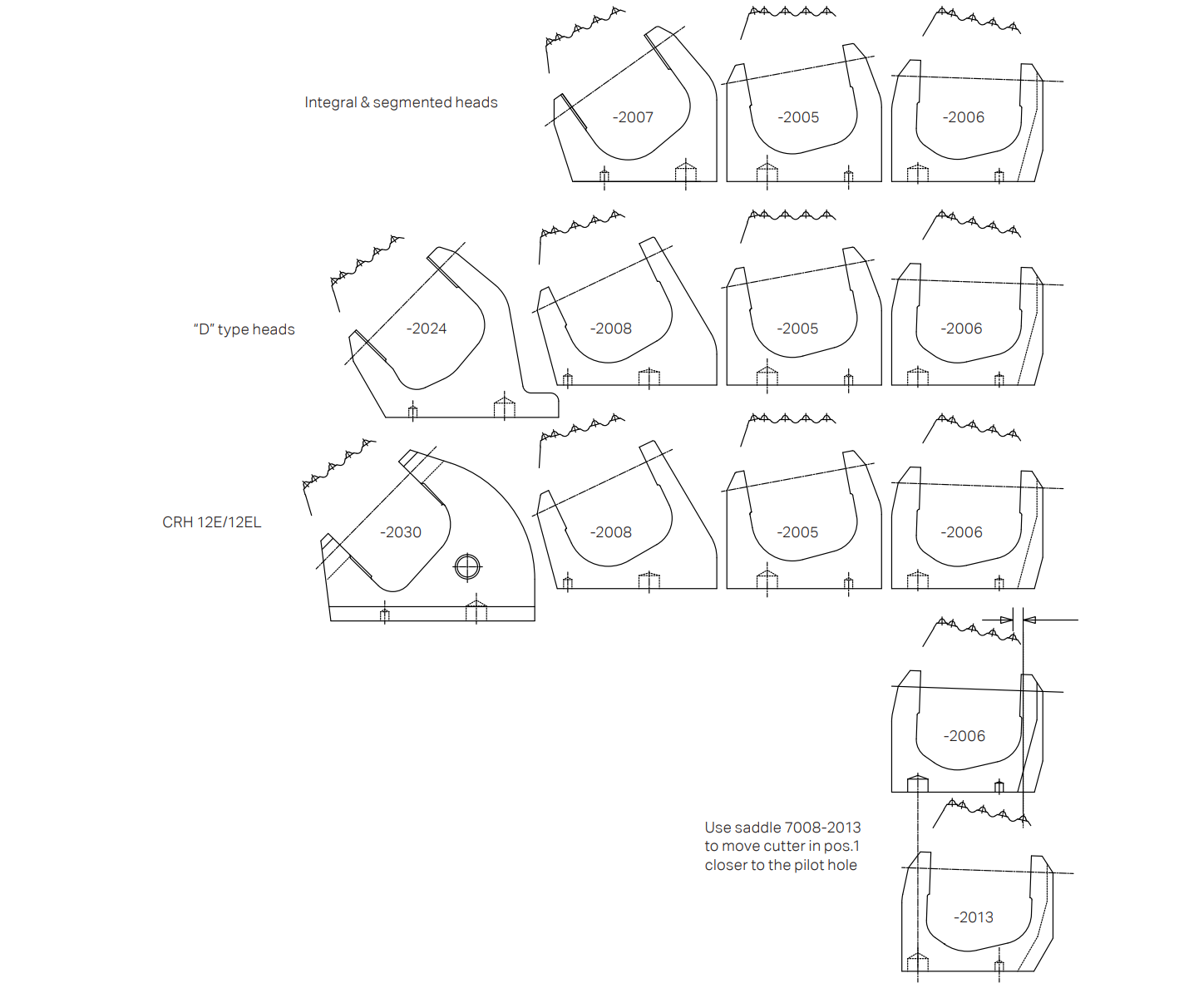
For maintenance crews and terminal users, reducing the reamer diameter via gauge saddle replacement must be executed with precision.
Preparation: Ensure the reaming head is securely blocked and stable. As per the foundational mounting rules, all contact surfaces on the head frame must be thoroughly cleaned, flattened, and oiled.
Removal of Existing Gauge Saddles: Carefully unbolt the outermost saddles. Inspect the dowel pins and threaded holes on the reaming head for any signs of galling, stretching, or fatigue.
Selection of the New Gauge Saddles: Identify the correct 7008-2XXX part numbers that correspond to your newly desired shaft diameter. (Note: Some additional saddles are specifically modified for small diameter reaming heads. Always consult the manufacturer's specific sizing chart to ensure compatibility).
Positioning: Align the new gauge saddles using the dowel pins. Pay strict attention to the position marks on the side of the head frame.
Torque Application: Utilize new bolts and nuts. Apply the two-stage crosswise torque methodology: first to 2/3 strength (approx. 800 Nm), and finally to the full 1200 Nm. Re-use Nord-lock washers only if they pass a rigorous physical inspection.
The most vital instruction for end-users utilizing the "D" type gauge saddle system is maintaining perfect symmetry. The manufacturer issues a strict, non-negotiable directive regarding the outermost cutters.
Important! Make sure to use four gauge saddles of the same type (same part number and marking) together on the reamer at all times to keep the correct profile.
A raise boring reaming head operates on the principle of balanced dynamic forces. As the head rotates and is pulled upward with immense hydraulic thrust, the forces exerted by the rock against the cutters must cancel each other out across the diameter of the head.
When four identical gauge saddles are used, the outermost cutters scribe a perfectly circular, uniform track. The lateral forces pushing against the reaming head are balanced, keeping the drill string perfectly centered within the pilot hole.
If a maintenance crew mixes different gauge saddles—for example, using two saddles for a 2.1m diameter and two for a 2.0m diameter—the consequences are severe:
Asymmetrical Cutting Profile: The cutters will no longer track in a single, uniform groove. Instead, they will fight each other, creating a stepped or irregular shaft wall.
Severe Lateral Deflection (Wobble): Because the radial forces are unbalanced, the reaming head will be violently pushed away from the side with the larger gauge saddles. This introduces a severe "wobble" into the entire system.
Pilot Hole and Drill String Damage: The lateral deflection forces the stem of the reaming head to grind aggressively against the walls of the pilot hole. This can cause the pilot hole to collapse, severely damage the stem fit, and introduce bending stresses into the drill pipe that can lead to catastrophic string failure (snapped pipes).
Uneven Cutter Wear: The cutters mounted on the mismatched saddles will bear an unequal load, leading to premature bearing failure and shattered carbide buttons.
To prevent this, site managers must ensure strict inventory control, verifying that all four gauge saddles share the exact same 7008-2XXX part number and physical markings before they are transported to the mounting deck.
The term "dressing" refers to the specific configuration and layout of saddles and cutters on a reaming head. The most frequent dressings rely heavily on the 7008-2XXX series.
The number of different saddle types required for a complete dressing varies directly with the reaming head's diameter and type. A massive 4.0-meter head will require a much more complex dressing—with numerous intermediate saddles bridging the gap between the inner saddles (Positions 1 & 2) and the gauge saddles—compared to a 1.5-meter head.
Terminal users operating in confined spaces or boring smaller utility raises should note that some saddles are specially modified for small-diameter reaming heads. Because the real estate on a small head frame is highly limited, standard saddles might physically interfere with one another. These modified saddles possess a smaller physical footprint while still maintaining the structural integrity required to withstand the 1200 Nm torque specifications and boring forces.
The transition to "D" type reaming heads and modular gauge saddles offers profound benefits to the terminal user's bottom line:
Capital Expenditure Reduction: Instead of purchasing three different reaming heads to handle three different shaft designs, a mining operation can purchase a single "D" type core frame and three relatively inexpensive sets of gauge saddles.
Underground Logistics: Transporting a 10-ton reaming head down a mine shaft and through narrow drifts requires heavy machinery and significant time. Transporting four gauge saddles can be done quickly in the back of a light utility vehicle.
Inventory Optimization: Warehousing modular saddles requires a fraction of the space needed to store fully built reaming heads. It also simplifies the procurement process for replacement parts.
Downtime Minimization: If an outer cutter or saddle is damaged by falling rock, the crew only needs to replace the localized gauge saddle rather than pulling the entire head for a complete overhaul.
The implementation of the improved gauge saddle system on "D" type reaming heads represents a major leap forward in raise boring technology. By allowing terminal users to reduce reamer diameters simply by changing the outer saddles, manufacturers have drastically improved operational flexibility and reduced logistical overhead.
However, this modularity requires strict adherence to mechanical discipline. Terminal users must meticulously prepare mounting surfaces, adhere to the 1200 Nm crosswise torque procedures, and above all, respect the Rule of Four. By ensuring that four identical gauge saddles are used at all times, operators will maintain a balanced cutting profile, protect their drill string, and guarantee the highly efficient rock excavation that modern raise boring demands.
This website uses cookies to ensure you get the best experience on our website.





 Phone
Phone E-mail