
Lowering Your Cost-per-meter: Why Choosing Premium DI22 Stabilizers Matters
In the high-stakes environment of underground mining, the phrase "cheap is expensive" is a reality that many operations face the hard way. When planning a large-scale ventilation shaft or ore pass project, the immediate urge to cut costs by selecting lower-grade drilling components is understandable. However, in the realm of raise boring, the true cost is not measured by the purchase price of a Drill Rod—it is measured by the cost-per-meter (CPM).
For mining contractors and operations managers, the efficiency of the drill string is the single most significant factor in controlling project overheads. Investing in premium DI22 Raise Drill Rods and Stabilizers is not an added expense; it is a strategic maneuver designed to optimize your CPM and protect your bottom line.
When you choose non-premium, budget-tier drilling components, you are often borrowing efficiency from the future. The hidden costs associated with substandard equipment typically manifest in three areas:
Unscheduled Downtime: A failed drill rod or a seized thread isn’t just a maintenance issue; it is a total operational halt. In a deep shaft project, every hour the machine remains idle while the string is retrieved or repaired represents lost revenue and wasted labor costs.
Increased Wear on Machine Components: When your drill string lacks the necessary rigidity or precision, the raise boring machine itself bears the brunt of the vibration and misalignment. This leads to accelerated wear on the machine's drive head, bearings, and hydraulic systems.
The Cost of Re-Drilling: If a stabilizer fails to maintain the correct trajectory and the pilot hole deviates from the planned path, the cost of re-aligning or correcting the shaft can be astronomical.
Premium hardware like the DI22 system is engineered specifically to eliminate these variables. By integrating high-performance stabilizers into your string, you are fundamentally changing the economics of the project:
The DI22 stabilizer is built for longevity. By utilizing advanced wear-resistant materials and optimized tungsten carbide inserts, these stabilizers retain their gauge and stability long after standard components would have worn down. When your equipment lasts 30–50% longer in the hole, you reduce the frequency of "trip-outs" to change tooling, effectively increasing your productive drilling hours per shift.
A stable drill string is a healthy drill string. By significantly reducing the vibration and lateral movement that causes fatigue, DI22 stabilizers protect the structural integrity of your rods. This extends the service life of your entire drill string, delaying the capital expenditure required to replace the entire set.
The goal of any raise boring project is to hit the target with minimal deviation. Our DI22 stabilizers are engineered to keep the drill string centralized, ensuring the final shaft diameter and verticality meet your project specifications. Avoiding the need for "remedial works"—the expensive process of fixing a poorly drilled shaft—is where you see the most significant impact on your project's ROI.
For contractors bidding on competitive projects in Western Australia or across global mining markets, the ability to guarantee a project completion date is a major competitive advantage.
Using high-performance DI22 equipment allows you to:
Bid with Confidence: You can factor in higher daily penetration rates because you have more reliable equipment.
Optimize Labor Costs: Your crew spends less time performing emergency repairs and more time on actual drilling.
Reduce Inventory Carrying Costs: Because our components last longer, your need to stock surplus rods and stabilizers at remote mine sites is significantly reduced.
At the end of the day, your project's success is defined by how effectively you can convert your budget into completed, accurate shafts. Choosing DI22 Raise Drill Rods and Stabilizers is an investment in predictability. By mitigating the risks of downtime, equipment failure, and deviation, you are effectively lowering your cost-per-meter and securing a higher margin on every project.
Don't let the short-term appeal of lower upfront costs compromise your long-term operational performance.
Partner with us to optimize your drilling economics. Contact our technical team today to analyze your current drilling parameters and discover how switching to the DI22 system can enhance your operational profitability.
| Material Specifications | |||
| The utilized alloy steel is specifically adapted for the high demands of raise bore equipment. We provides raise bore equipment as Medium Strength, High Strength and Ultra-High Strength Series. | |||
| Medium Strength Series | |||
| Material: Alloy Steel, ref. AISI 4330 - available for Raise Bore Rods: 8", 10", 111/4", 12 78" | |||
| Property | Symbol | Dimension | Raw Material Diameter 200 mm to 350 mm |
| Yield Strength | RP0.2 | N/mm² | ≥ 930 (135 ksi) |
| Tensile Strength | Rm | N/mm² | ≥ 1030 (149 ksi) |
| Elongation after Fracture (Lo O 4x do) | A4 | % | ≥ 15 |
| Reduction of Area | Z | % | ≥ 45 |
| Notch Impact Strength Charpy V-Notch | A | J | ≥ 65 |
| Hardness on Specific Diameter | - | HB | 320 - 370 |
| Hardness on Circumferential Surf | - | HB | ≥ 340 |
| High Strength Series | |||
| Material: Alloy Steel, ref. AISI 4330 mod — available for Raise Bore Rods: 8", 10", 11 ¼", 12 ⅞" | |||
| Property | Symbol | Dimension | Raw Material Diameter 200 mm to 350 mm |
| Yield Strength | RP0.2 | N/mm² | ≥ 965 (140 ksi) |
| Tensile Strength | Rm | N/mm² | ≥ 1035 (150 ksi) |
| Elongation after Fracture (Lo O 4x do) | A4 | % | ≥ 15 |
| Reduction of Area | Z | % | ≥ 45 |
| Notch Impact Strength Charpy V-Notch | A | J | ≥ 65 |
| Hardness on Specific Diameter | - | HB | 320 - 380 |
| Hardness on Circumferential Surf | - | HB | ≥ 340 |
| Ultra-High Strength Series | |||
| Material: Alloy Steel, ref. AISI 4330 V mod — available for Raise Bore Rods: 10", 11 ¼", 12 ⅞", 15" | |||
| Property | Symbol | Dimension | Raw Material Diameter 200 mm to 385 mm |
| Yield Strength | RP0.2 | N/mm² | ≥ 1030 (149 ksi) |
| Tensile Strength | Rm | N/mm² | ≥ 1110 (161 ksi) |
| Elongation after Fracture (Lo O 4x do) | A4 | % | ≥ 14 |
| Reduction of Area | Z | % | ≥ 45 |
| Notch Impact Strength Charpy V-Notch | A | J | ≥ 65 |
| Hardness on Specific Diameter | - | HB | 330 - 390 |
| Hardness on Circumferential Surf | - | HB | ≥ 340 |
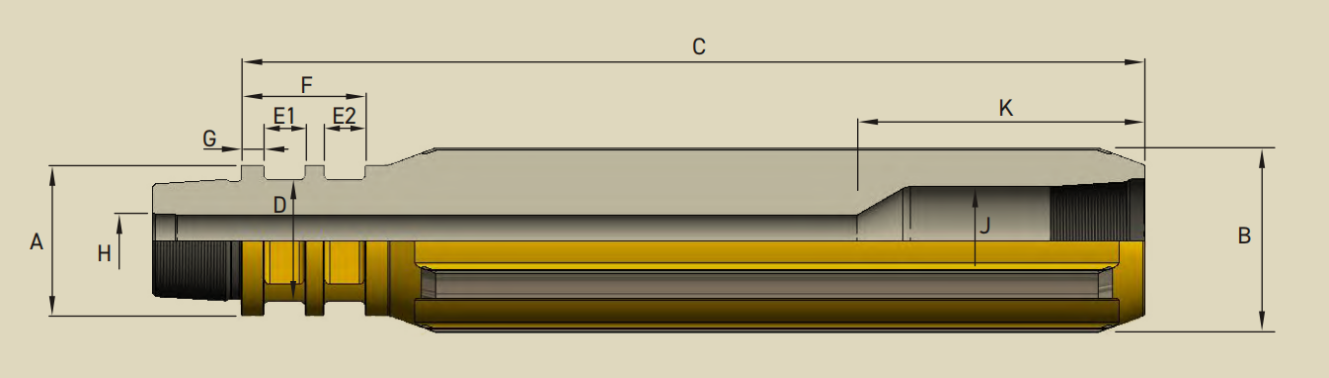
| DI22 Stabilizers | |||||||||||
| OD | Thread | Length | Wrenching | Length | ID | Length | |||||
| Body | Hole | Pin x Box | S/S | Square | Width | S/1st Flat | S/2nd Flat | Body | BoreBack | ||
| A | B | — | C | D | E1 | E2 | F | G | H | J | K |
| Standard Dimensions -imperial: | |||||||||||
| 10" | 11" 12 ¼" 13 ¾" | 8 ¼" DI-22 | 48" 60" | 8" 8 ¼" | 2 ¾" | 2 ¾" | 8 ¼" | 1 ½" | 3 ⅜" | 7 ⅛" | 19" 36" |
| 11 ¼" | 12 ¼" 13 ¾" | 9 ¼" DI-22 | 48" 60" | 9" 9 ¼" | 2.95" 3 ½" | 2.95" 3 ½" | 8.85" 10" | 1.58" 2 ½" | 4 ¾" | 8" | 19" 36" |
| 12 7/8" | 13 ¾" 15" 16" 17 ½" | 10 ½”, DI-22 | 48" 60" | 10" 10 ½" | 3 ½" | 3 ½" | 11 ½" | 2 ½" | 5 7/16" | 9" | 19" 36" |
| Standard Dimensions -metric: | |||||||||||
| 254.0mm | 279.4 mm 311.1 mm 349.2 mm | 8 ¼" DI-22 | 1219.2 mm 1524.0 mm | 203.2 mm 209.5 mm | 69.8 mm | 69.8 mm | 209.5 mm | 38.1 mm | 85.7 mm | 181.0 mm | 482.6 mm 914.2 mm |
| 285.7 mm | 311.1 mm 349.2 mm | 9 ¼" DI-22 | 1219.2 mm 1524.0 mm | 228.6 mm 234.9 mm | 75.0 mm 88.9 mm | 75.0 mm 88.9 mm | 224.8 mm 254.0 mm | 40 mm 63.5 mm | 120.5 mm | 203.2 mm | 482.6 mm 914.2 mm |
| 327.0mm | 349.2 mm 381.0 mm 406.4 mm 444.5 mm | 10 ½”, DI-22 | 1219.2 mm 1524.0 mm | 254.0 mm 266.7 mm | 88.9 mm | 88.9 mm | 292.1 mm | 63.5mm | 138.1mm | 228.6mm | 482.6 mm 914.4 mm |
This website uses cookies to ensure you get the best experience on our website.





 Phone
Phone E-mail