
Engineering Superiority: The Metallurgical Science Behind High-Performance Raise Bore Drill Rods
In the demanding landscape of underground mining, where drilling integrity can mean the difference between a project completed on time and an expensive, project-halting failure, the foundation of your equipment is paramount. While many view drill rods as commodity items, at the highest levels of mining engineering, they are recognized as sophisticated, high-precision tools.
The difference between a rod that survives the grueling conditions of high-torque, deep-shaft development and one that suffers catastrophic fatigue failure lies in its material specification and metallurgical integrity. In this article, we examine how the strategic selection of alloy steels and rigorous manufacturing processes underpin the durability of our Medium, High, and Ultra-High Strength Series raise bore equipment.
Raise boring is a process characterized by extreme torsional stress, intense radial pressure, and constant cyclic loading. To resist these forces, our equipment is forged from specialized alloy steels, specifically refined based on AISI 4330 standards, with advanced modifications to meet the unique challenges of the mining industry.
For standard shaft sinking projects, our Medium Strength Series utilizes AISI 4330 Alloy Steel. With a minimum yield strength of 930 N/mm² (135 ksi) and a tensile strength of 1030 N/mm² (149 ksi), this series provides an optimal balance of structural rigidity and cost-effectiveness. It is engineered for operations where consistent performance across 8", 10", 11 1/4", and 12 7/8" rod diameters is required without the need for extreme-environment specifications.
As projects demand higher load-bearing capabilities, our High Strength Series transitions to an AISI 4330 mod alloy. This refined composition elevates the yield strength to ≥ 965 N/mm² (140 ksi). The addition of sophisticated alloying elements enhances the steel's hardenability, ensuring that the rods maintain their shape and integrity even when subjected to the high-vibration environments typical of hard-rock raise boring.
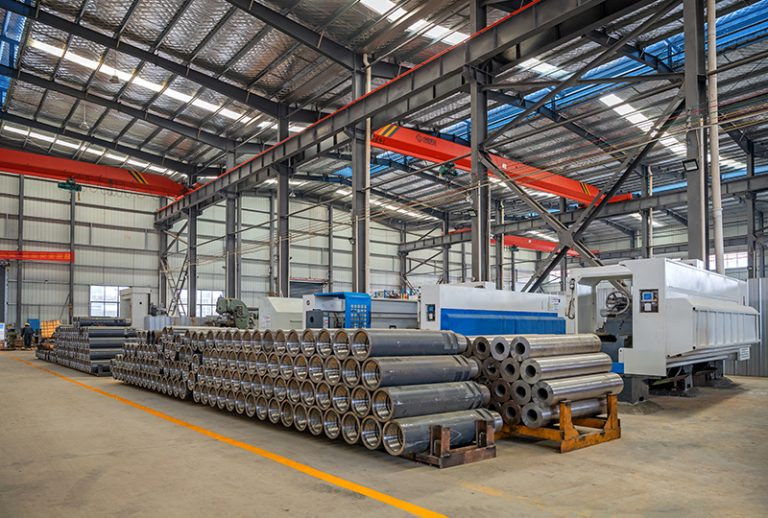
When mining in deep-strata environments with high Unconfined Compressive Strength (UCS), standard alloys simply cannot suffice. Our Ultra-High Strength Series utilizes AISI 4330 V mod alloy, achieving a yield strength of ≥ 1030 N/mm² (149 ksi) and a tensile strength of ≥ 1110 N/mm² (161 ksi). This series is the flagship solution for the most demanding projects, available in diameters up to 15".
Understanding the "Raw Material Diameter" context (200 mm to 385 mm) is crucial for appreciating our quality control. The mechanical properties of a drill rod are not just determined by chemical composition, but by how that composition responds to heat treatment across its entire cross-section.
Yield strength is the critical threshold where a rod will permanently deform. By pushing our yield benchmarks to ≥ 1030 N/mm² in our Ultra-High Strength Series, we ensure that the drill string remains within its elastic limit even under the extreme torque of modern high-power raise bore rigs.
A common misconception is that "stronger" must mean "harder." However, extreme hardness without ductility leads to brittleness. Our rods maintain a Reduction of Area (Z) of ≥ 45% and Elongation after Fracture (A4) of ≥ 14–15% across all series. This controlled ductility allows the drill rod to "give" slightly under shock loads, absorbing the vibrational energy that would otherwise cause micro-cracks in less-resilient equipment.
The Notch Impact Strength (Charpy V-Notch ≥ 65 J) is our benchmark for safety and reliability. This metric confirms that the material can absorb significant energy during impact without initiating a crack. In the harsh, unpredictable environment of an underground shaft, this impact toughness is the primary insurance against catastrophic string failure.
The metallurgical properties of our rods are achieved through a precise, multi-stage heat treatment process. We focus on two specific zones of hardness to ensure operational longevity:
Hardness on Specific Diameter: Maintaining a range of 320–390 HB ensures the core of the rod is tough enough to resist fatigue while remaining ductile enough to prevent brittle failure.
Hardness on Circumferential Surface: To combat abrasive wear from rock Cuttings and friction within the borehole, we target a circumferential surface hardness of ≥ 340 HB. This localized hardening is critical for preserving the outer diameter of the rod over thousands of meters of drilling.
For mine operators, the technical specifications outlined in our material data sheets translate directly into operational realities:
Extended Mean Time Between Failures (MTBF): By utilizing the Ultra-High Strength Series in abrasive rock, you minimize the frequency of unplanned string retrievals, directly increasing your drilling uptime.
Precision and Verticality: The structural rigidity provided by our AISI 4330-based alloys ensures that the drill string remains true, reducing the cost of borehole deviation and potential remedial work.
Reduced Total Cost of Ownership: While high-performance alloys represent a premium upfront investment, their longevity and resistance to wear make them the most cost-effective solution when calculated against the Cost-per-meter (CPM).
At the heart of every successful raise bore project is a drill string that you can trust. Our commitment to the AISI 4330 series of alloys, combined with our rigorous standards for impact resistance, tensile strength, and surface hardness, is not just about meeting specifications—it is about providing the security that your operational goals are supported by the best materials science available.
Whether your project requires the flexibility of our Medium Strength Series or the uncompromising power of our Ultra-High Strength Series, you can be confident that our drill rods are engineered to perform at the limits of their metallurgical potential.
Are you ready to optimize your raise boring performance with materials designed for the future of deep-shaft mining? Contact our technical support team to discuss which of our steel series best suits your project’s geological conditions and load requirements. Let’s engineer the success of your next shaft together.
This website uses cookies to ensure you get the best experience on our website.





 Phone
Phone E-mail