


Percussive Drilling in Mining
Percussive drilling is one of the most important methods used in mining to break hard rock efficiently. It is based on a simple principle: a drill bit repeatedly strikes the rock surface with high force while rotating. These repeated impacts, or percussions, create cracks in the rock, and the rotation helps remove broken material and advance the hole. Because of this combination of impact and rotation, percussive drilling is especially effective in very hard and abrasive rock formations where other drilling methods may be less efficient.In mining operations, percussive drilling is commonly used for blasting holes, exploration holes, and production drilling. The holes drilled are usually filled with explosives in blasting operations to fragment the rock mass. This makes it easier to excavate ore or waste rock and improves overall mine productivity. Percussive drilling is also useful in underground mining, where space may be limited and precision is important. The method can be applied in both surface and underground environments, making it a flexible solution for many mining conditions.A typical percussive drilling system includes a drill rig, a drill bit, drill rods, and a hammer mechanism. The hammer can be located at the top of the drill string or near the drill bit. In top-hammer systems, the impact force travels through the drill rods to the bit. In down-the-hole systems, the hammer is positioned closer to the bit, which reduces energy loss and improves performance in deeper holes. Each system has its own advantages depending on hole depth, rock hardness, and required drilling accuracy.One of the main advantages of percussive drilling is its high penetration rate in tough rock. It can produce holes quickly while maintaining good control over direction and depth. It is also relatively reliable and well suited to operations that require repeated drilling over long periods. In addition, modern drilling equipment can be automated or remotely controlled, improving safety and reducing operator exposure to hazardous areas.However, percussive drilling also has some limitations. It can generate significant noise, vibration, and dust, which must be managed carefully to protect workers and equipment. Tool wear can be high in very abrasive rock, leading to increased maintenance and replacement costs. Energy consumption may also be considerable, especially when drilling large numbers of holes. For these reasons, effective maintenance, dust suppression, and operator training are essential.Overall, percussive drilling remains a fundamental technique in mining because of its strength, versatility, and effectiveness in hard rock conditions. It supports efficient rock fragmentation and contributes directly to safer and more productive mining operations.
Products
Category:
-
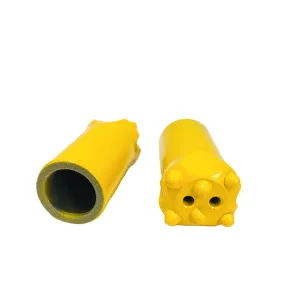
Taper Rock Bit vs Standard Metal Drill: Percussive Drilling in Mining
Category: Tapered Connection Drill BitBrowse number: 41Number:Release time: 2026-04-23 02:30:40A taper rock bit is designed for percussive drilling in hard rock (granite, basalt), not for metal cutting.
News
Category:
No search results found!
Case
Category:
No search results found!
Video
Category:
No search results found!
Download
Category:
No search results found!
Job
Category:
No search results found!
Featured Products
No search results found!



 Phone
Phone E-mail